The Alchemy of the Fragment: Turning the Inside Out
We are rarely a single, solid story. Instead, we are a collection of echoes, sudden flashes of light, and the quiet weight of shadows. We are made of fragments: the jagged edge of a morning argument, the velvet texture of a dream, the precise blue of a winter sky.
To live only in the mind is to leave these pieces scattered. But when we pick up a brush, a charcoal stick, or a pair of scissors, we begin the sacred process of taking the inside out. Art-making is not about “rendering” the world as it appears; it is about exhaling the world as it feels. It is an imaginative bridge that allows the invisible currents of the soul to take a physical seat at the table.
The Soul’s Scrapbook: Life as an Annotated Visual Essay
Think of your life not as a locked diary, but as an annotated visual essay. In a traditional journal, we often demand logic from ourselves. We want sentences that make sense. But our internal lives are rarely logical.
By shifting to a visual practice, you allow yourself to speak in the language of the subconscious—a dialect of color, texture, and symbol.
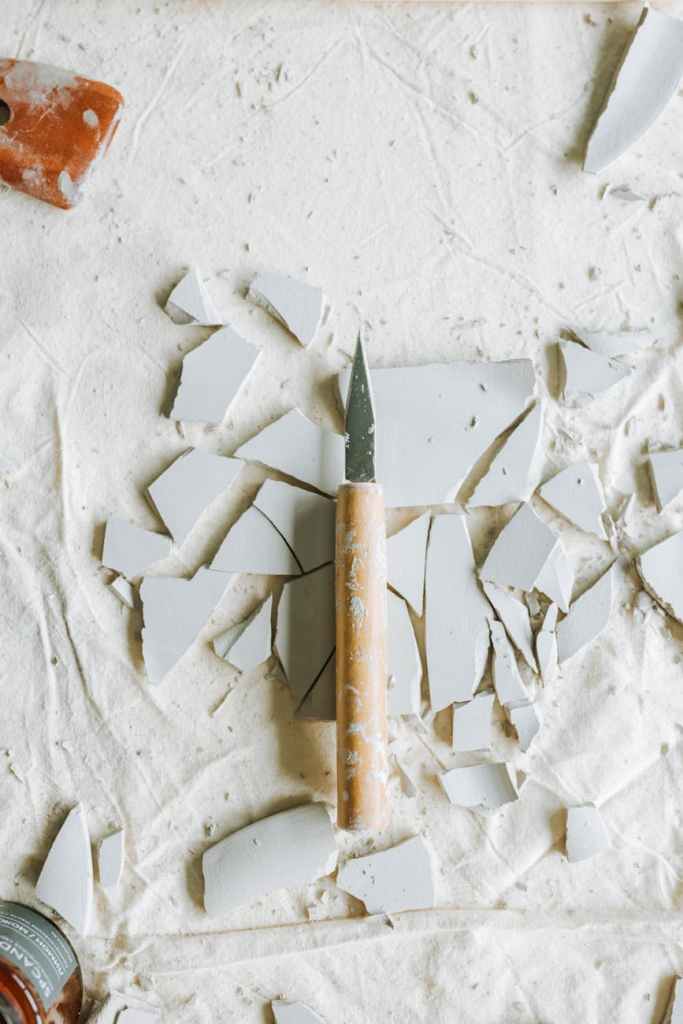
* The Power of the Fragment: A torn piece of a map, a dried leaf, or a heavy stroke of crimson paint doesn’t need to explain itself. These are “fragments of being.” When you glue them down, you are acknowledging that a messy, broken piece of your day still belongs to the whole.
* The Dialogue of Annotation: The magic happens in the margin. Next to a chaotic swirl of ink, you might write: “This is how the wind felt when I realized I was lost.” Next to a delicate, golden thread, you whisper: “The hope that survived the winter.” This is the “annotation”—the bridge between the raw image and your conscious heart.
Turning the Invisible into the Tangible
When we create, we perform a kind of gentle collage. That heavy, nameless anxiety that sits in your chest? Give it a color. Give it a texture. Is it sandpaper? Is it a deep, murky violet? Once it is on the page, it is no longer you it is something you are looking at.
In this space, you are no longer the victim of your emotions; you are their curator. You are the architect of your own experience, rearranging the shards until they catch the light.
How to Begin Your Visual Pilgrimage
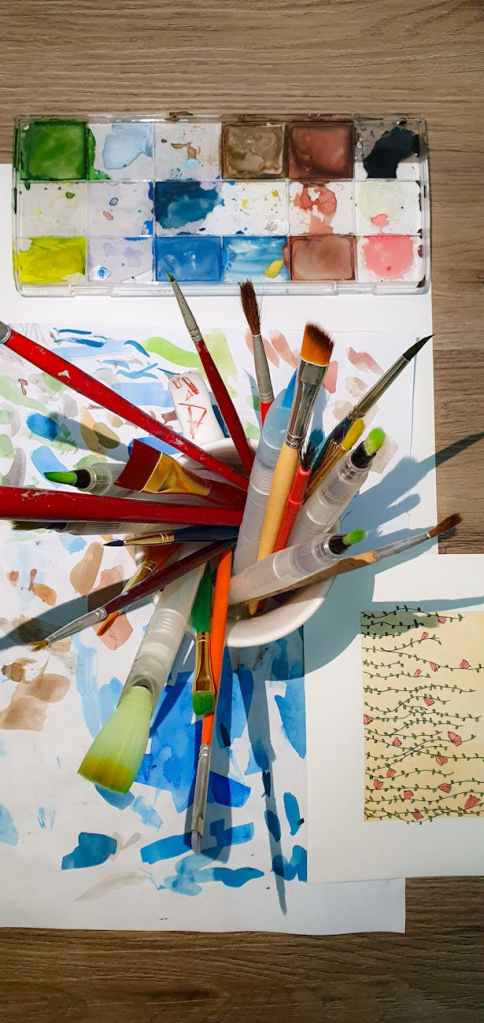
Lower the Stakes: Your journal is not a gallery; it is a laboratory. Use “ugly” materials if it helps cardboard, old mail, a child’s crayon. Let the hand move before the brain can object.
Collect the “Small Throws”: Gather bits of your day that resonate. A receipt from a coffee date, a ticket stub, a leaf from a walk. These are the physical anchors of your internal voyage.
Layer the Silence: Paint over your words. Write over your drawings. Let the layers build up, just as time layers our memories. Some things are meant to be hidden, and some are meant to bleed through.
Listen to the Composition: After a week, look at your pages. You will see a map emerging. You will see that the fragments however disparate are starting to hum the same tune.
The Composition of a Life
We are all works in progress, a grand collage of moments that haven’t quite dried yet. By treating your life as a visual essay, you stop waiting for the “big picture” to make sense and start finding beauty in the bits and pieces.
You are the artist. You are the essayist. And your life, in all its fragmented glory, is the masterpiece.
 Holly B.F. Warren
Atelierista Artist Mind Wanderer Writer Optimist
Holly B.F. Warren
Atelierista Artist Mind Wanderer Writer Optimist 